Install Pigsty for Production
How to install Pigsty on Linux hosts for production?
Unlike Getting Started, production Pigsty deployments require more Architecture Planning and Preparation.
This chapter helps you understand the complete deployment process and provides best practices for production environments.
Before deploying to production, we recommend testing in Pigsty’s Sandbox to fully understand the workflow. Use Vagrant to create a local 4-node sandbox, or leverage Terraform to provision larger simulation environments in the cloud.
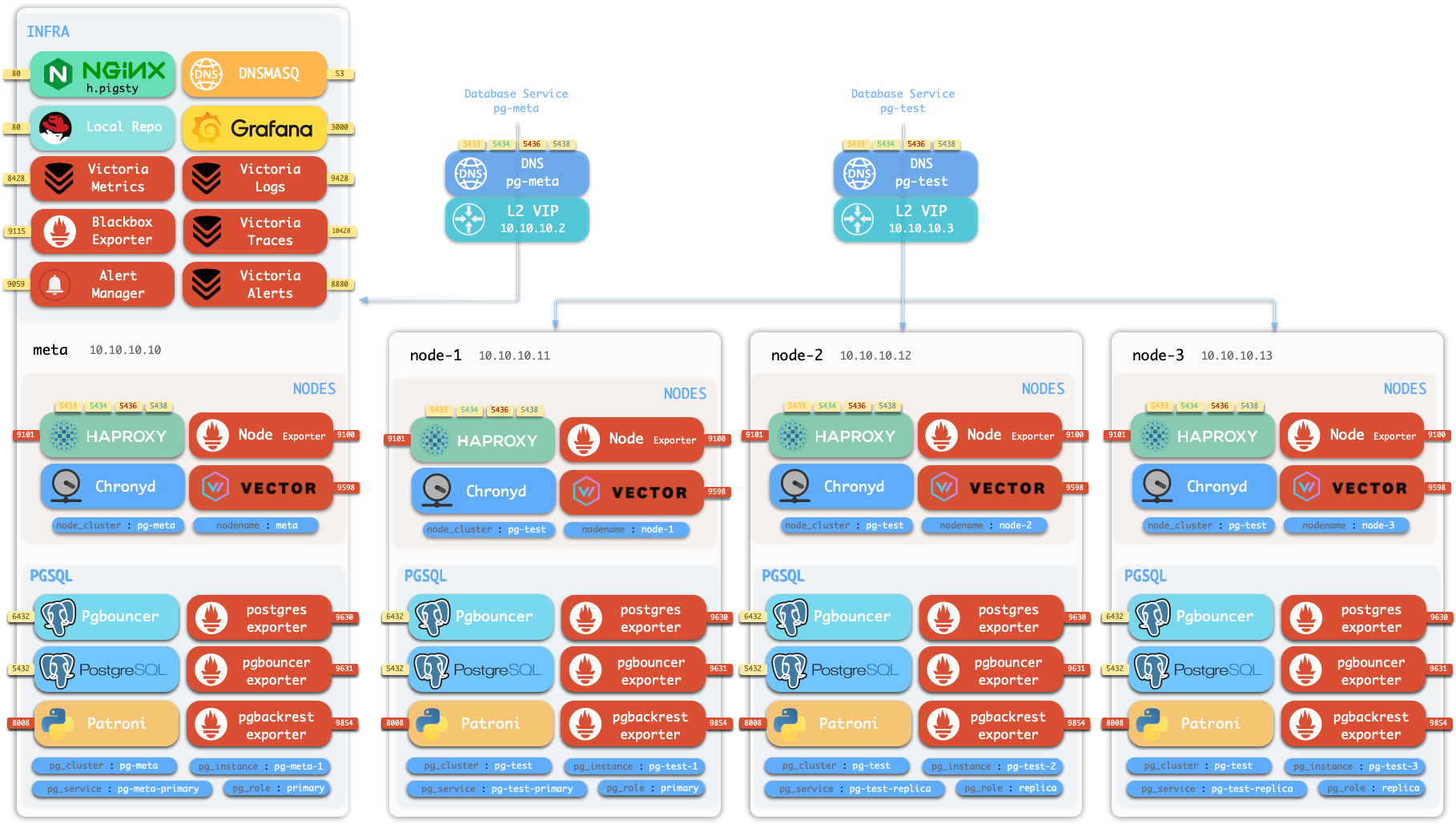
For production, you typically need at least three nodes for high availability. You should understand Pigsty’s core Concepts and common administration procedures, including Configuration, Ansible Playbooks, and Security Hardening for enterprise compliance.
How to install Pigsty on Linux hosts for production?
Production deployment preparation including hardware, nodes, disks, network, VIP, domain, software, and filesystem requirements.
How many nodes? Which modules need HA? How to plan based on available resources and requirements?
Admin user, sudo, SSH, accessibility verification, and firewall configuration
4-node sandbox environment for learning, testing, and demonstration
Create local virtual machine environment with Vagrant
Create virtual machine environment on public cloud with Terraform
Security considerations for production Pigsty deployment
Was this page helpful?
Thanks for the feedback! Please let us know how we can improve.
Sorry to hear that. Please let us know how we can improve.