Tags: Pigsty
Pigsty v4.3: 510 Extensions & Ubuntu 26
May 04, 2026 in Pigsty

Pigsty v4.3 adds 50 PostgreSQL extensions, bringing the total to 510. It also adds Ubuntu 26.04 x86_64/arm64 support, refreshes Supabase, pgEdge, PolarDB, Grafana, MinIO, and a batch of infra packages.
Pigsty v4.3 adds 50 PostgreSQL extensions, bringing the total to 510. It also adds Ubuntu 26.04 x86_64/arm64 support, refreshes Supabase, pgEdge, PolarDB, Grafana, MinIO, and a batch of infra packages.
Pigsty v4.2: 12 Kernels
February 28, 2026 in Pigsty

GitHub Release | Release Note v4.2.0 Release Note Highlights Aligned with PostgreSQL out-of-band minor updates: 18.3, 17.9, 16.13, 15.17, 14.22. Total PostgreSQL extension coverage reaches 461 packages. Kernel updates across Babelfish, AgensGraph, …
GitHub Release | Release Note v4.2.0 Release Note Highlights Aligned with PostgreSQL out-of-band minor updates: 18.3, 17.9, 16.13, 15.17, 14.22. Total PostgreSQL extension coverage reaches 461 packages. Kernel updates across Babelfish, AgensGraph, …
Pigsty v4.1: Day-Zero 18.2 Support
February 12, 2026 in Pigsty

Same-day production support for new PG minors is the core message of Pigsty v4.1. In this release cycle, Pigsty and AWS/EDB were among the very few to announce production readiness for PG 18.2 on day one.
Same-day production support for new PG minors is the core message of Pigsty v4.1. In this release cycle, Pigsty and AWS/EDB were among the very few to announce production readiness for PG 18.2 on day one.
The Agent Moat: Runtime
February 06, 2026 in Database

A mediocre local who knows the terrain beats a genius parachuted into unknown territory. Intelligence without context is idle. An agent without a runtime is vapor.
A mediocre local who knows the terrain beats a genius parachuted into unknown territory. Intelligence without context is idle. An agent without a runtime is vapor.
From AGPL to Apache: Why I Changed Pigsty's License
January 29, 2026 in PostgreSQL
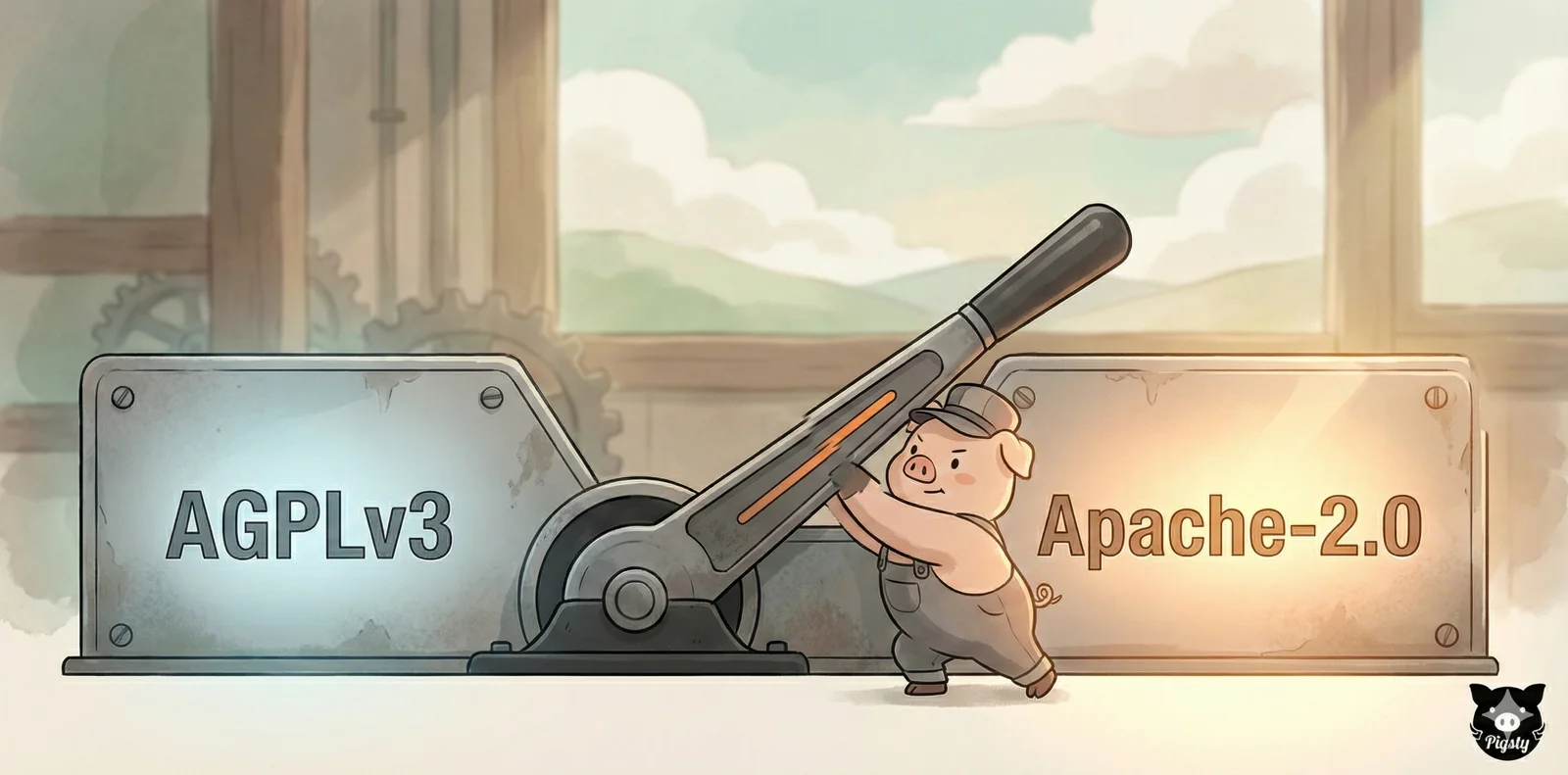
Pigsty switched from AGPLv3 to Apache 2.0. Aren't you worried about freeloaders? Freeloaders welcome — if you want to become the Debian of databases, a permissive license is table stakes.
Pigsty switched from AGPLv3 to Apache 2.0. Aren't you worried about freeloaders? Freeloaders welcome — if you want to become the Debian of databases, a permissive license is table stakes.
Pigsty v4.0: Victoria Stack + Security Hardening
January 28, 2026 in Pigsty

VictoriaMetrics/Logs replace Prometheus/Loki for 10x observability performance, Vector handles logs, unified UI, firewall/SELinux/credential hardening.
VictoriaMetrics/Logs replace Prometheus/Loki for 10x observability performance, Vector handles logs, unified UI, firewall/SELinux/credential hardening.
Pigsty v3.7: PostgreSQL Magneto Award, PG18 Deep Support
December 03, 2025 in Pigsty

PostgreSQL 18 becomes the default version, EL10 and Debian 13 support added, extensions reach 437, and Pigsty wins the PostgreSQL Magneto Award.
PostgreSQL 18 becomes the default version, EL10 and Debian 13 support added, extensions reach 437, and Pigsty wins the PostgreSQL Magneto Award.
Forging a China-Rooted, Global PostgreSQL Distro
November 27, 2025 in PostgreSQL

PostgreSQL already won. The real battle is the distro layer. Will Chinese developers watch from the sideline or craft a PG “Ubuntu” for the world?
PostgreSQL already won. The real battle is the distro layer. Will Chinese developers watch from the sideline or craft a PG “Ubuntu” for the world?
Pigsty v3.6: The Ultimate PostgreSQL Distribution
July 25, 2025 in Pigsty

New doc site, PITR playbook, Percona PG TDE kernel support, and Supabase self-hosting optimization make v3.6 the last major release before 4.0.
New doc site, PITR playbook, Percona PG TDE kernel support, and Supabase self-hosting optimization make v3.6 the last major release before 4.0.
Pigsty v3.5: 4K Stars, PG18 Beta, 421 Extensions
May 01, 2025 in Pigsty

Pigsty crosses 4K GitHub stars, adds PG18 beta support, pushes extensions to 421, ships new doc site, and completes OrioleDB/OpenHalo full-platform support.
Pigsty crosses 4K GitHub stars, adds PG18 beta support, pushes extensions to 421, ships new doc site, and completes OrioleDB/OpenHalo full-platform support.
Pigsty v3.4: PITR Enhancement, Locale Best Practices, Auto Certificates
March 18, 2025 in Pigsty

Pigsty v3.4 adds pgBackRest backup monitoring, cross-cluster PITR restore, automated HTTPS certificates, locale best practices, and full-platform IvorySQL and Apache AGE support.
Pigsty v3.4 adds pgBackRest backup monitoring, cross-cluster PITR restore, automated HTTPS certificates, locale best practices, and full-platform IvorySQL and Apache AGE support.
Pigsty v3.3: 404 Extensions, Turnkey Apps, New Website
February 20, 2025 in Pigsty

Pigsty v3.3 pushes available extensions to 404, adds turnkey app deployment with app.yml, delivers Certbot integration for automated HTTPS, and launches a redesigned website.
Pigsty v3.3 pushes available extensions to 404, adds turnkey app deployment with app.yml, delivers Certbot integration for automated HTTPS, and launches a redesigned website.
Pigsty v3.2: The pig CLI, Full ARM Support, Supabase & Grafana Enhancements
December 19, 2024 in Pigsty

Pigsty v3.2 introduces the pig CLI for PostgreSQL package management, complete ARM64 extension repository support, and Supabase & Grafana enhancements.
Pigsty v3.2 introduces the pig CLI for PostgreSQL package management, complete ARM64 extension repository support, and Supabase & Grafana enhancements.
Pigsty v3.1: One-Click Supabase, PG17 Default, ARM & Ubuntu 24
October 28, 2024 in Pigsty

Pigsty v3.1 makes PostgreSQL 17 the default, delivers one-click Supabase self-hosting, adds ARM64 and Ubuntu 24.04 support, and simplifies configuration management.
Pigsty v3.1 makes PostgreSQL 17 the default, delivers one-click Supabase self-hosting, adds ARM64 and Ubuntu 24.04 support, and simplifies configuration management.
Pigsty v3.0: Pluggable Kernels & 340 Extensions
October 01, 2024 in Pigsty

Pigsty v3.0 ships 340 extensions across EL/Deb with full parity, adds pluggable kernels (Babelfish, IvorySQL, PolarDB) for MSSQL/Oracle compatibility, and delivers a local-first state-of-the-art RDS experience.
Pigsty v3.0 ships 340 extensions across EL/Deb with full parity, adds pluggable kernels (Babelfish, IvorySQL, PolarDB) for MSSQL/Oracle compatibility, and delivers a local-first state-of-the-art RDS experience.
Pigsty v2.7: The Extension Superpack
July 12, 2024 in Pigsty

Pigsty v2.7 bundles 255 PostgreSQL extensions, plus Docker templates for Odoo, Supabase, PolarDB, and Jupyter, with new PITR dashboards.
Pigsty v2.7 bundles 255 PostgreSQL extensions, plus Docker templates for Odoo, Supabase, PolarDB, and Jupyter, with new PITR dashboards.
Pigsty v2.6: PostgreSQL Crashes the OLAP Party
February 28, 2024 in Pigsty

Pigsty v2.6 makes PostgreSQL 16.2 the default, introduces ParadeDB and DuckDB support, and brings epic-level OLAP improvements.
Pigsty v2.6 makes PostgreSQL 16.2 the default, introduces ParadeDB and DuckDB support, and brings epic-level OLAP improvements.
Pigsty v2.5: Ubuntu & PG16
December 01, 2023 in Pigsty

Pigsty v2.5 adds Ubuntu/Debian support (bullseye, bookworm, jammy, focal), new extensions including pointcloud and imgsmlr, and redesigned monitoring dashboards.
Pigsty v2.5 adds Ubuntu/Debian support (bullseye, bookworm, jammy, focal), new extensions including pointcloud and imgsmlr, and redesigned monitoring dashboards.
Pigsty v2.4: Monitor Cloud RDS
October 01, 2023 in Pigsty

Pigsty v2.4 delivers PostgreSQL 16 GA support, RDS/PolarDB monitoring, Redis Sentinel HA, and a wave of new extensions including Apache AGE, zhparser, and pg_embedding.
Pigsty v2.4 delivers PostgreSQL 16 GA support, RDS/PolarDB monitoring, Redis Sentinel HA, and a wave of new extensions including Apache AGE, zhparser, and pg_embedding.
Pigsty v2.3: Richer App Ecosystem
August 24, 2023 in Pigsty

Pigsty v2.3 adds FerretDB MongoDB support, NocoDB integration, L2 VIP for node clusters, PostgreSQL security patches, and Redis 7.2.
Pigsty v2.3 adds FerretDB MongoDB support, NocoDB integration, L2 VIP for node clusters, PostgreSQL security patches, and Redis 7.2.
Pigsty v2.2: Monitoring System Reborn
July 22, 2023 in Pigsty

Pigsty v2.2 delivers a complete monitoring dashboard overhaul built on Grafana 10, a 42-node production simulation sandbox, Pigsty's own RPM repos, and UOS compatibility.
Pigsty v2.2 delivers a complete monitoring dashboard overhaul built on Grafana 10, a 42-node production simulation sandbox, Pigsty's own RPM repos, and UOS compatibility.
Pigsty v2.1: Vector + Full PG Version Support!
June 10, 2023 in Pigsty

Pigsty v2.1 provides support for PostgreSQL 12 through 16, with PGVector for AI embeddings.
Pigsty v2.1 provides support for PostgreSQL 12 through 16, with PGVector for AI embeddings.
Pigsty v2.0: Open-Source RDS PostgreSQL Alternative
February 28, 2023 in Pigsty

Pigsty v2.0 delivers major improvements in security, compatibility, and feature integration — truly becoming a local open-source RDS alternative.
Pigsty v2.0 delivers major improvements in security, compatibility, and feature integration — truly becoming a local open-source RDS alternative.
Pigsty v1.5: Docker Application Support, Infrastructure Self-Monitoring
May 05, 2022 in Pigsty

Complete Docker support, infrastructure self-monitoring, ETCD as DCS, better cold backup support, and CMDB improvements.
Complete Docker support, infrastructure self-monitoring, ETCD as DCS, better cold backup support, and CMDB improvements.
Pigsty v1.4: Modular Architecture, MatrixDB Data Warehouse Support
March 14, 2022 in Pigsty

Pigsty v1.4 introduces a modular architecture with four independent modules, adds MatrixDB time-series data warehouse support, and delivers global CDN acceleration.
Pigsty v1.4 introduces a modular architecture with four independent modules, adds MatrixDB time-series data warehouse support, and delivers global CDN acceleration.
Pigsty v1.3: Redis Support, PGCAT Overhaul, PGSQL Enhancements
November 10, 2021 in Pigsty

Pigsty v1.3 adds Redis support with three deployment modes, rebuilds the PGCAT catalog explorer, and enhances PGSQL monitoring dashboards.
Pigsty v1.3 adds Redis support with three deployment modes, rebuilds the PGCAT catalog explorer, and enhances PGSQL monitoring dashboards.
Pigsty v1.2: PG14 Default, Monitor Existing PG
October 22, 2021 in Pigsty

Pigsty v1.2 makes PostgreSQL 14 the default version and adds support for monitoring existing database instances independently.
Pigsty v1.2 makes PostgreSQL 14 the default version and adds support for monitoring existing database instances independently.
Pigsty v1.1: Homepage, Jupyter, Pev2, PgBadger
September 17, 2021 in Pigsty

Pigsty v1.1.0 ships with a redesigned homepage, plus JupyterLab, PGWeb, Pev2 & PgBadger integrations.
Pigsty v1.1.0 ships with a redesigned homepage, plus JupyterLab, PGWeb, Pev2 & PgBadger integrations.
Pigsty v1.0: GA Release with Monitoring Overhaul
July 26, 2021 in Pigsty

Pigsty v1.0.0 GA is here — a batteries-included, open-source PostgreSQL distribution ready for production.
Pigsty v1.0.0 GA is here — a batteries-included, open-source PostgreSQL distribution ready for production.
Pigsty v0.9: CLI + Logs
May 31, 2021 in Pigsty

One-click installs, a beta CLI, and Loki-based logging make Pigsty easier to land.
One-click installs, a beta CLI, and Loki-based logging make Pigsty easier to land.
Ready-to-Use PostgreSQL Distribution: Pigsty
May 24, 2021 in PostgreSQL

Yesterday I gave a live presentation in the PostgreSQL Chinese community, introducing the open-source PostgreSQL full-stack solution: Pigsty.
Yesterday I gave a live presentation in the PostgreSQL Chinese community, introducing the open-source PostgreSQL full-stack solution: Pigsty.
Pigsty v0.8: Service Provisioning
May 14, 2021 in Pigsty

Services are now first-class objects, so you can define any routing policy—built-in HAProxy, L4 VIPs, or your own balancer.
Services are now first-class objects, so you can define any routing policy—built-in HAProxy, L4 VIPs, or your own balancer.
Pigsty v0.7: Monitor-Only Deployments
April 26, 2021 in Pigsty

Monitor-only deployments unlock hybrid fleets, while DB/user provisioning APIs get a serious cleanup.
Monitor-only deployments unlock hybrid fleets, while DB/user provisioning APIs get a serious cleanup.
Pigsty v0.6: Provisioning Upgrades
April 19, 2021 in Pigsty

v0.6 reworks the provisioning flow, adds exporter toggles, and makes the monitoring stack portable across environments.
v0.6 reworks the provisioning flow, adds exporter toggles, and makes the monitoring stack portable across environments.
Pigsty v0.5: Declarative DB Templates
March 28, 2021 in Pigsty

Pigsty v0.5 introduces declarative database templates so roles, schemas, extensions, and ACLs can be described entirely in YAML.
Pigsty v0.5 introduces declarative database templates so roles, schemas, extensions, and ACLs can be described entirely in YAML.
Pigsty v0.4: PG13 and Better Docs
March 01, 2021 in Pigsty

Pigsty v0.4 ships PG13 support, a Grafana 7.3 refresh, and a cleaned-up docs site for the second public beta.
Pigsty v0.4 ships PG13 support, a Grafana 7.3 refresh, and a cleaned-up docs site for the second public beta.
Pigsty v0.3: First Public Beta
December 14, 2020 in Pigsty

Pigsty v0.3.0, the first public beta, lands with eight battle-tested dashboards and an offline bundle.
Pigsty v0.3.0, the first public beta, lands with eight battle-tested dashboards and an offline bundle.